
One of the most overlooked but meaningful relationships is the balance between Free T3 and Reverse T3.
Understanding T3 and Reverse T3
Free T3
Free T3 is the active thyroid hormone. It plays a key role in:
- metabolism and energy production
- body temperature regulation
- fat burning and muscle maintenance
- mental clarity and mood
When Free T3 is properly utilized, the body can efficiently convert fuel into energy.
Reverse T3 (rT3)
Reverse T3 is an inactive or blocking form of thyroid hormone. It binds to the same receptors as T3, but does not activate them. In functional medicine, elevated Reverse T3 is often viewed as a protective stress response — the body slows metabolism to conserve energy during times of:
- chronic stress
- inflammation
- under-fueling or extreme dieting
- illness or unresolved hormonal imbalance
Why the T3 / Reverse T3 Ratio Is Important
Looking at T3 or Reverse T3 alone rarely tells the full story.
The T3 / Reverse T3 ratio helps us understand:
- whether T3 is reaching and activating your cells
- how stress and inflammation may be impacting thyroid function
- why symptoms persist despite “normal” thyroid labs
A higher Reverse T3 level can interfere with how effectively your body uses T3 — even when Free T3 appears adequate on paper.
This is why many people feel unwell despite being told their thyroid is fine.
How to Calculate the T3 / Reverse T3 Ratio
Because these markers are often reported in different units, conversion is necessary.
Example values
Free T3: 5.2 pmol/L
Reverse T3: 0.32 ng/mL
Unit conversion
1 ng/mL = 3.461 pmol/L
0.32 × 3.461 = 1.107 pmol/L
Formula
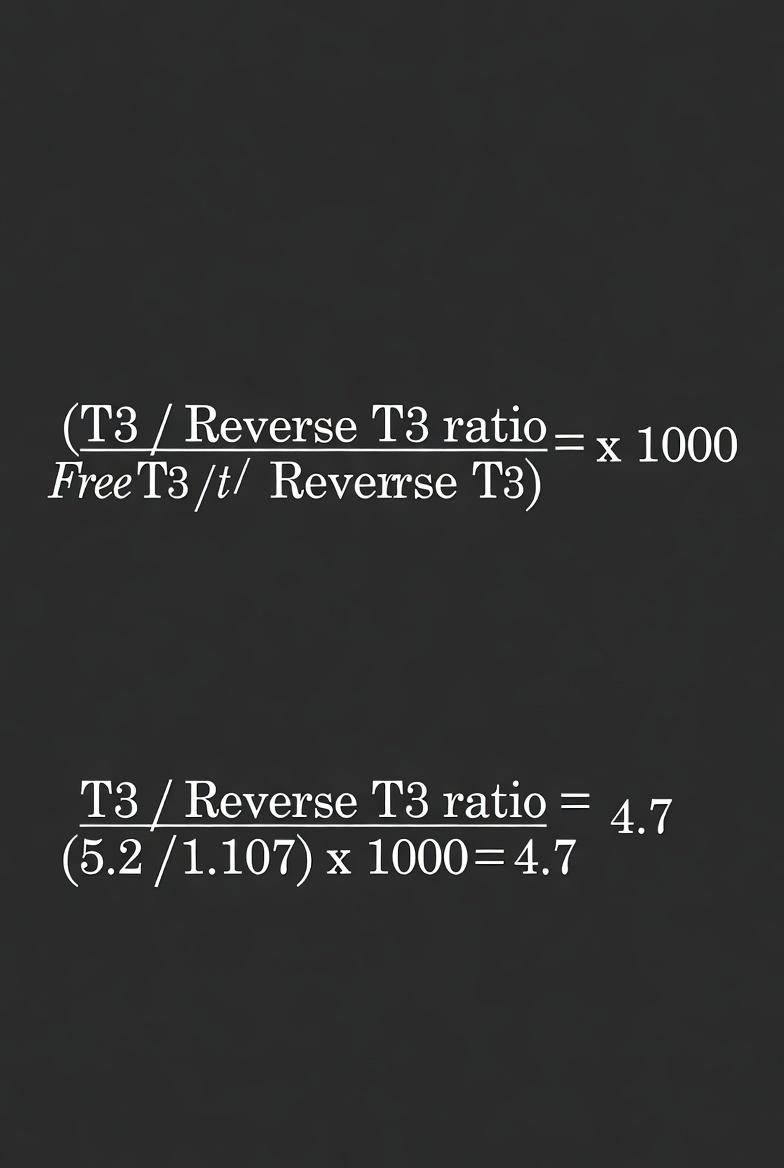
T3 / Reverse T3 Ratio = (Free T3 ÷ Reverse T3) × 1000
(5.2 ÷ 1.107) × 1000 ≈ 4.7
How to Interpret the Ratio
Why This Matters for Your Health
When T3 is not properly utilized at the cellular level, the body may shift into a conservation mode.
This can contribute to symptoms such as:
- persistent fatigue
- difficulty losing weight
- cold intolerance
- low motivation or mood changes
- feeling “stuck” despite doing everything right
From a functional perspective, this is not a failure of the body — it is a signal.
A Functional Perspective to Consider
Rather than forcing the system, functional medicine asks:
- Why is the body prioritizing survival over metabolism?
- What stressors are driving Reverse T3 production?
- What does the body need to feel safe enough to restore balance?
Addressing nervous system stress, nutrient status, inflammation, digestion, and lifestyle patterns is often essential for improving this ratio.
Important Note
This information is educational and not a diagnosis. If thyroid symptoms persist, lab results should always be reviewed with a qualified healthcare professional who understands both conventional and functional perspectives.Tip
If you suspect thyroid imbalance, consider asking your provider to look beyond reference ranges and evaluate how your hormones interact — not just whether they fall within “normal” limits. Hormonal balance is foundational to energy, metabolism, and long-term wellbeing. When we listen closely, the body often tells us exactly what it needs.